
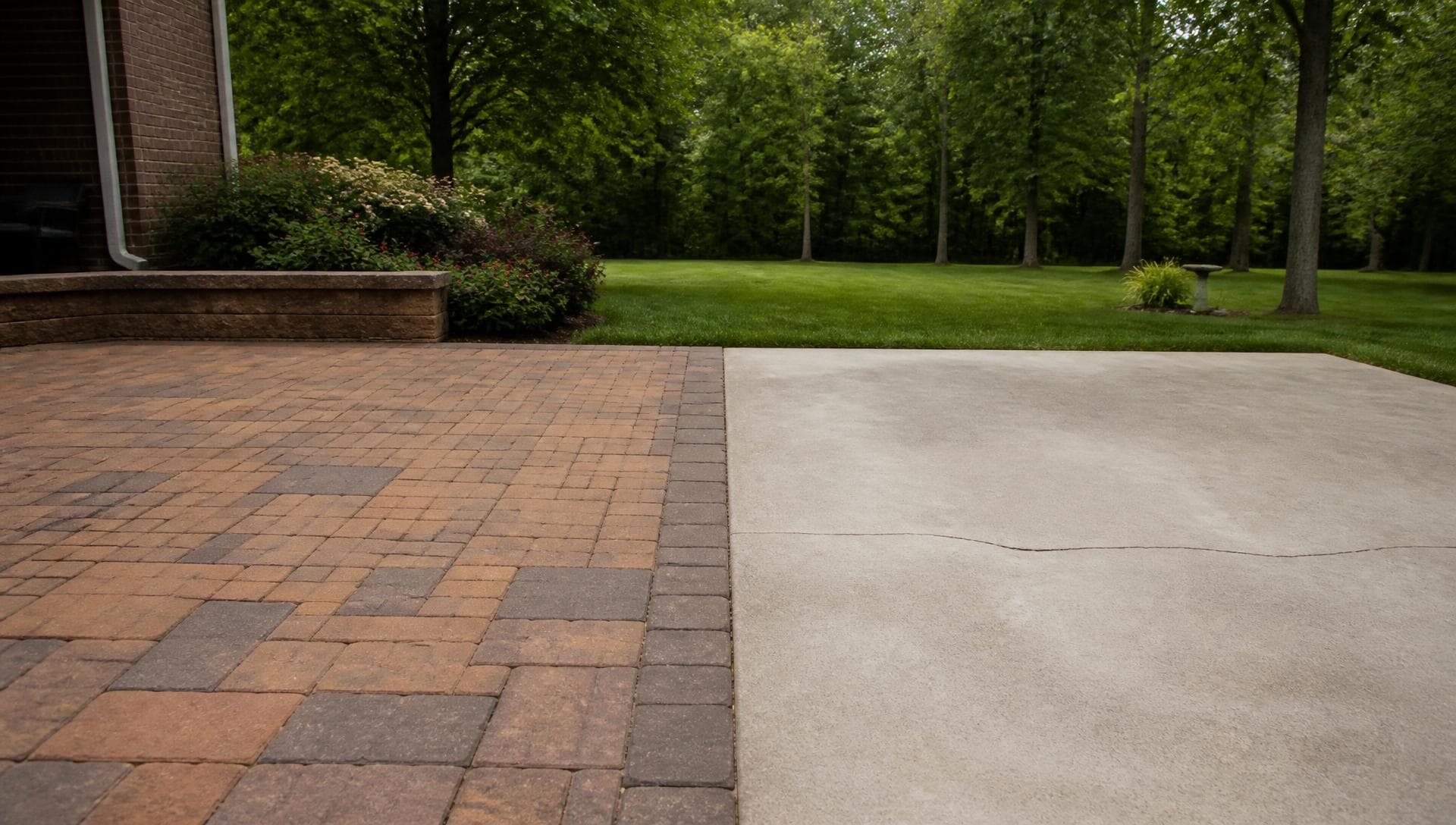
Planning a new patio in Central Kentucky? The first big decision most homeowners face is the surface itself — interlocking pavers or poured concrete. Both can produce a beautiful outdoor space, but they behave very differently once Kentucky weather gets involved. Here is an honest comparison from a crew that installs and repairs both.
The short answer for most Kentucky homeowners is that pavers hold up better through our freeze-thaw winters and are far easier to repair, while poured concrete offers a smooth, seamless look with a simpler installation. Which one is right for you depends on how you weigh durability, appearance, maintenance, and drainage. Let's break each factor down.
Why Kentucky's Climate Is the Deciding Factor
Central Kentucky sits in a humid subtropical zone with real winters. In Lexington, temperatures typically swing from the mid-20s in winter to the mid-80s in summer, and the National Weather Service climate records for the area show regular snowfall and freezing spells most winters, with precipitation spread throughout the year.
That combination — abundant moisture plus repeated trips above and below freezing — is what patio builders call freeze-thaw cycling. Water gets into a surface or the soil beneath it, freezes, expands, and pushes. Then it thaws and everything settles. Repeat that dozens of times each winter and any rigid surface is under stress. Your patio choice is really a choice about how the surface handles that stress.
How Poured Concrete Handles Freeze-Thaw
A poured concrete patio is a single rigid slab. When the ground beneath it heaves with frost or settles unevenly, the slab cannot flex — it cracks. Control joints help direct where cracking happens, but they cannot prevent it. Deicing salts add a second problem, since some deicing chemicals contribute to surface scaling and deterioration on cast-in-place concrete, as documented by the Concrete Masonry and Hardscapes Association.
Concrete's genuine strengths are a clean, continuous surface, a wide range of finishes including stamping and staining, and a straightforward installation. For covered areas or spaces that stay relatively dry, it performs well. The trade-off shows up when repairs are needed — a cracked or spalled section cannot be invisibly patched, and significant damage often means cutting out and re-pouring.
How Pavers Handle Freeze-Thaw
An interlocking paver patio works differently. Instead of one rigid slab, it is hundreds of small, dense concrete units set on a compacted aggregate base with sand joints. That structure is flexible by design — when the ground moves, the system moves with it, then can be reset. The units themselves are manufactured to a higher density and lower absorption than typical poured concrete, which is exactly what freeze-thaw and deicing-salt durability standards for paving units are built around.
Pavers also have a repair advantage that matters over a patio's lifetime. A stained, chipped, or settled section can be lifted, the base corrected, and the same units relaid — no saw cuts, no color-mismatched patches. And because water moves through the joints rather than sheeting off a slab, a well-built paver patio contributes less to runoff. The EPA highlights permeable pavements as one way properties can reduce stormwater runoff, which is a genuine benefit on lots where water management is already a concern.
The honest trade-offs with pavers are a more involved installation — excavation, base compaction, edge restraint, and joint sand all have to be done right — and occasional joint maintenance such as re-sanding.
Appearance, Comfort, and Design Flexibility
Concrete offers a uniform, modern look and takes stamping or staining well. Pavers offer variety — shapes, blends, borders, and patterns that can be matched to your home and combined with retaining walls, walkways, and other hardscaping features for a cohesive design. Neither is objectively better looking; it comes down to the style you want. Where pavers pull ahead again is that their appearance is easier to preserve, because damage can be corrected unit by unit.
So Which Should You Choose?
Choose poured concrete if you want a seamless contemporary surface, your site drains well, and you accept that cracking is a matter of when rather than if in our climate.
Choose pavers if long-term durability through Kentucky winters, repairability, and drainage flexibility are your priorities. For most of the paver patio projects we build around Georgetown, the freeze-thaw performance alone settles the question — it is the reason pavers are our most requested patio surface.
Whichever direction you lean, the base preparation underneath matters more than the surface you see. A poorly built base will undermine either material. That is where 18 years of installing patios in Scott and Fayette County soil makes the difference.
Frequently Asked Questions
Do pavers shift or become uneven over time?
Any surface can settle if the base beneath it fails. The difference is that settled pavers can be lifted and relaid, while a settled slab usually needs mudjacking or replacement.
Can you install pavers over an existing concrete patio?
In some cases, yes — an overlay can work if the existing slab is sound and drainage is handled properly. It requires an on-site assessment first.
How do I get an expert opinion on my patio project?
Reach out for a free estimate and we will look at your site, your drainage, and your design goals, then recommend the surface that genuinely fits — see our paver patio installation services for what a professional build includes.
Kingdom Landscapes and Irrigation — Georgetown, KY
Contact Number: 859-304-0636