
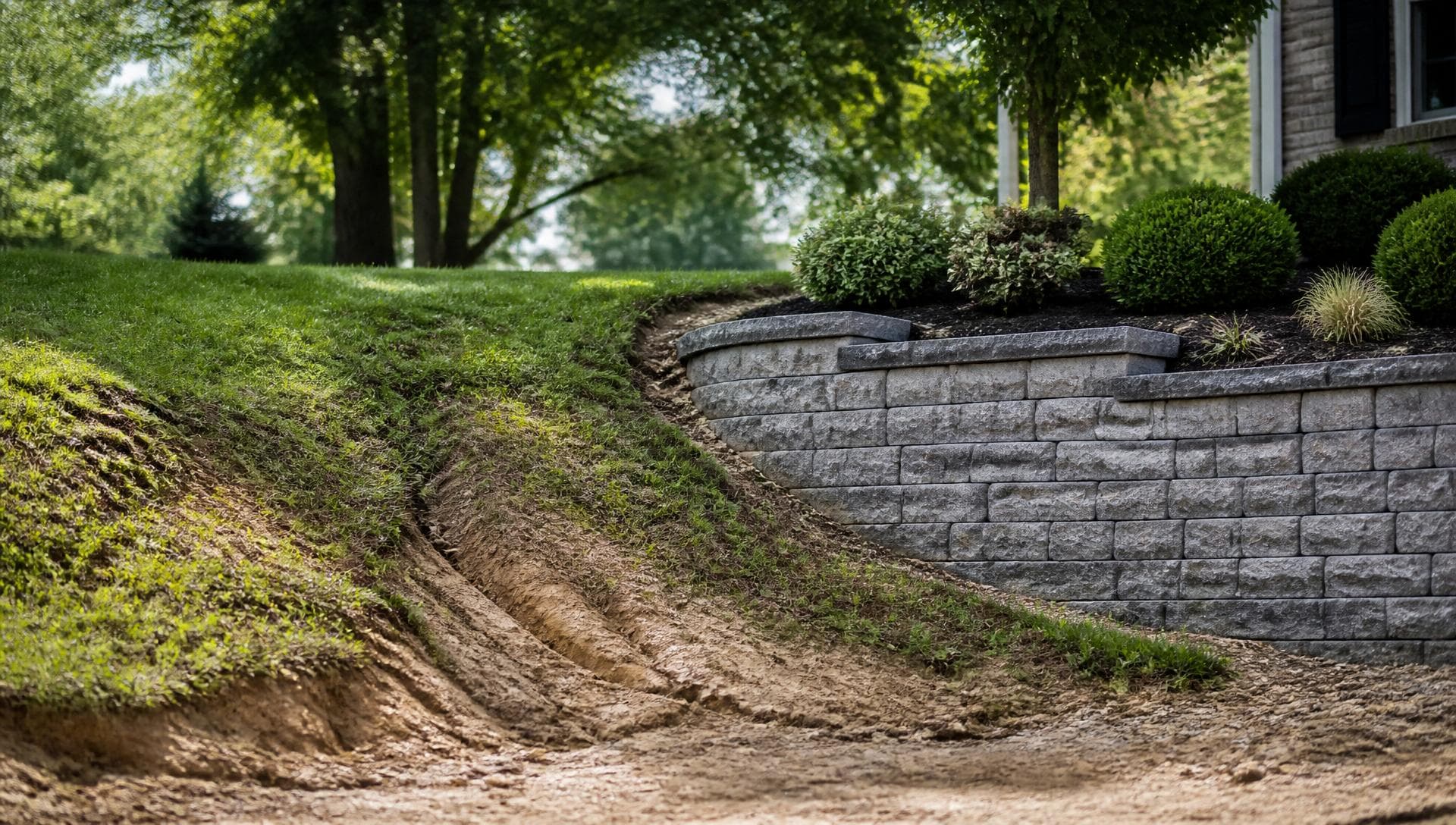
If part of your yard slopes, shifts, or washes out every time it rains, your property may be telling you something. Retaining walls are not just decorative features — they are structural solutions that hold back soil, manage water, and protect everything downhill from driveways to foundations. So how do you know when a retaining wall is genuinely needed rather than simply nice to have?
The short answer is this. You need a retaining wall when soil on your property is actively moving, when water is carving channels through your landscape, or when a slope is threatening something you cannot afford to lose. Below are the most common warning signs we see across Georgetown, Scott County, and Fayette County, and what each one means for your yard.
Sign 1 — Soil Is Washing Away After Every Storm
Central Kentucky storms can drop a lot of water in a short window, and bare or sloped soil has nowhere to hold it. If you notice exposed roots, small gullies forming on a hillside, or mulch and topsoil collecting at the bottom of a slope, erosion is already underway. The EPA notes that unmanaged stormwater runoff accelerates soil and bank erosion, and once erosion starts, it compounds — every storm removes a little more of the material holding your slope together.
A properly engineered retaining wall interrupts that cycle. It shortens the slope, slows the water, and gives soil a permanent structure to rest against.
Sign 2 — A Slope Is Creeping Toward Your Home or Driveway
Soil under pressure does not stay put. If you have a bank behind your house that seems to inch closer each year, or a slope above your driveway that sheds rock and dirt onto the pavement, gravity is winning. This is one of the clearest cases for a retaining wall, because the consequences of doing nothing get more expensive over time.
Pay particular attention to slopes that sit above or below structures. Anything the soil is moving toward — a garage, a patio, a foundation — is what engineers call a surcharge situation, and it raises the stakes considerably.
Sign 3 — Your Yard Has Unusable Sloped Space
Not every retaining wall is a rescue mission. Sometimes the trigger is simpler — a steep section of yard you cannot mow, plant, or use. Segmental retaining walls can reclaim previously unusable areas and turn them into level, functional space, according to the Concrete Masonry and Hardscapes Association. A terraced hillside can become a garden, a play area, or a level pad for outdoor living.
If you are already considering broader upgrades, our hardscaping and landscape services team can design walls that solve the structural problem and improve how the whole space looks and functions.
Sign 4 — Water Pools Against Your Foundation
Grading problems and drainage problems travel together. If runoff from a slope is settling against your home instead of moving away from it, you have a two-part issue — the slope that is delivering the water and the low ground that is trapping it. The University of Kentucky Cooperative Extension emphasizes that good surface drainage is a must, with water channeled away from foundations, sidewalks, and driveways.
In these cases a retaining wall is often paired with drainage solutions such as French drains or regrading, so the wall manages the soil while the drainage system manages the water.
Sign 5 — An Existing Wall Is Leaning, Bulging, or Cracking
Already have a retaining wall? Watch it closely. Leaning faces, bulging sections, and stair-step cracks are signs the wall is losing its fight with the soil behind it — usually because water has built up where it should have been drained away. Industry installation guidance from the Concrete Masonry and Hardscapes Association stresses that retaining walls must resist both soil pressure and the loads placed above them, which is why proper base preparation, backfill, and drainage matter as much as the blocks you see.
A failing wall rarely improves on its own. Replacing or rebuilding it correctly — with the right drainage behind it — is almost always less costly than dealing with a collapse.
What Should You Do Next?
If you recognize any of these signs, the sensible first step is a professional assessment. Every slope is different, and the right answer depends on soil conditions, water flow, wall height, and what sits above and below the grade change. Taller walls and walls supporting driveways or structures may also require engineering review and local permits, so it pays to involve a professional early — check with your local building department before any wall project begins.
Kingdom Landscapes and Irrigation has spent 18 years building and repairing retaining walls across Georgetown and Scott County, and we have seen how Central Kentucky's storms and soils test them. We will tell you honestly whether you need a full retaining wall, a smaller landscape wall, a drainage fix, or a combination.
Frequently Asked Questions
Can I just regrade the slope instead of building a wall?
Sometimes. Gentle slopes with minor erosion can occasionally be solved with regrading and planting. But where space is tight, the grade change is significant, or something valuable sits at the bottom of the slope, a retaining wall is the durable answer.
Do small garden walls count as retaining walls?
Low decorative walls that hold back minimal soil are landscape walls rather than structural retaining walls. The warning signs above — moving soil, pooling water, pressure against structures — are what separate a design choice from a structural need.
How do I get started?
Contact us for a free estimate. We will walk your property, look at how water and soil are behaving, and recommend the right solution for your yard.
Kingdom Landscapes and Irrigation — Georgetown, KY
Contact Number: 859-304-0636