
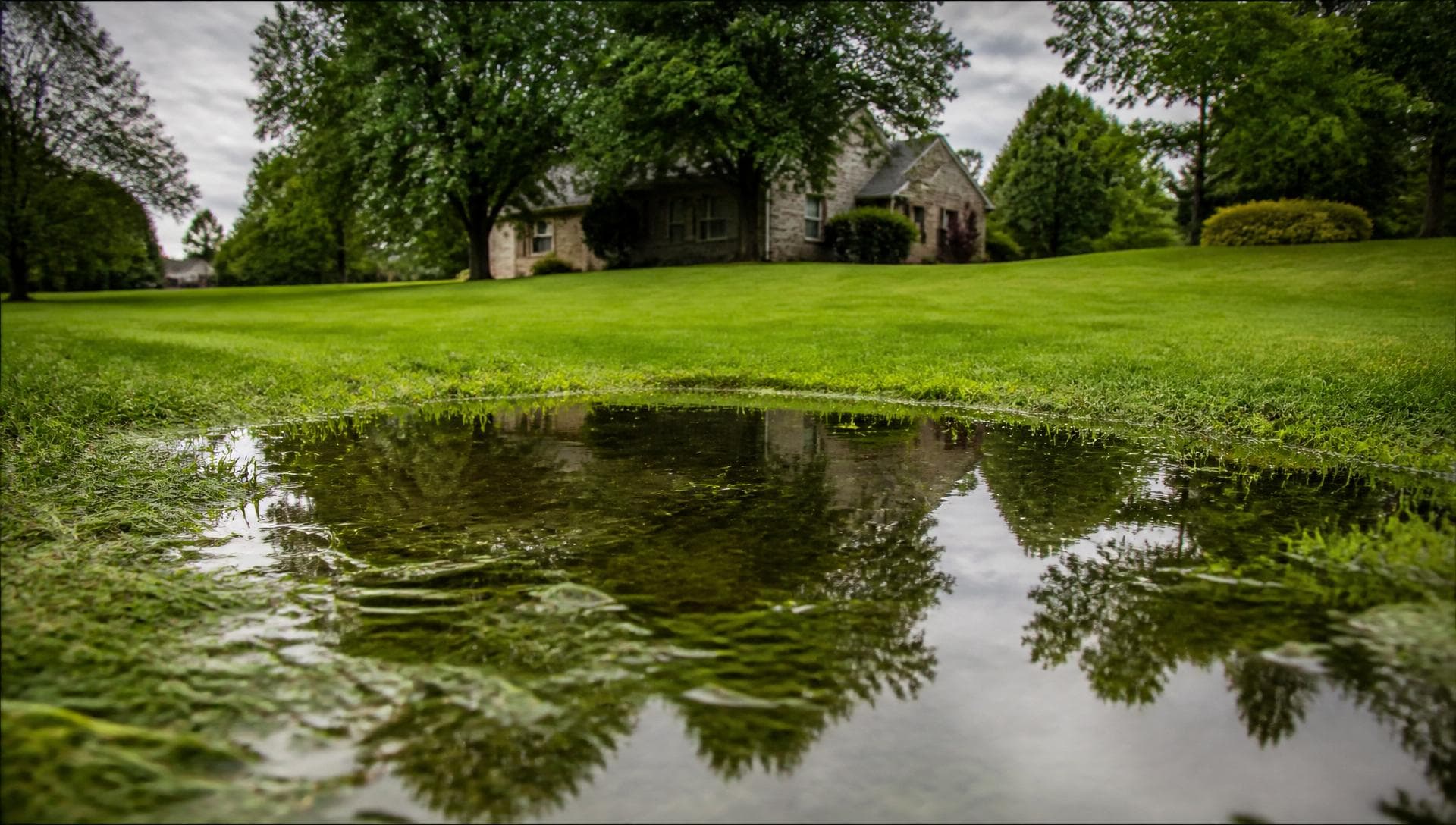
A drainage problem rarely announces itself all at once. It shows up as a soggy corner of the lawn, a musty smell near the crawl space, or a puddle that takes days to disappear after a summer thunderstorm. By the time most Georgetown homeowners call us, the water has usually been sending signals for a while.
So how do you know whether your yard has a genuine drainage problem or just a wet week? Here are the six signs we look for on every property assessment across Scott and Fayette County — and what each one is telling you.
1. Standing Water That Lingers After Rain
Rainwater should soak into the ground or move off your property within hours. If puddles are still sitting in the same spots a day or more after a storm, the water has nowhere to go — either the soil is too compacted to absorb it or the grading is holding it in place. The University of Kentucky Cooperative Extension notes that puddles forming during rain or irrigation indicate low spots that should be filled or drained, and that surface water must be channeled away from foundations, sidewalks, and driveways.
Persistent standing water also kills grass roots, invites mosquitoes, and turns lawn areas into mud. It is the single most common reason homeowners call us about drainage solutions in Georgetown.
2. A Lawn That Stays Spongy or Soggy
You should not sink when you walk across your yard two days after rain. A persistently soft, squishy lawn means the soil below is staying saturated — common in the clay-heavy soils we work with across Central Kentucky, which absorb water slowly and release it even more slowly. Saturated soil suffocates grass roots, encourages fungus and moss, and makes the lawn impossible to mow without rutting.
3. Water Stains, Dampness, or Musty Smells at the Foundation
This is the sign to take most seriously. If you see water marks on basement walls, damp spots in a crawl space, or efflorescence — the white mineral residue water leaves behind — the ground around your home is directing water toward the foundation instead of away from it. Downspouts that discharge right at the base of the house are frequent culprits; Michigan State University Extension highlights redirecting downspouts away from paved surfaces and foundations as one of the first fixes for runoff problems.
Foundation moisture problems only move in one direction if ignored, and the repair costs downstream are far larger than the drainage work that prevents them.
4. Erosion Channels, Exposed Roots, or Migrating Mulch
Water that moves too fast is just as damaging as water that does not move at all. Small gullies cut into slopes, tree roots that were not visible last year, and mulch that ends up at the bottom of the yard after every storm all point to uncontrolled runoff. The EPA notes that stormwater runoff drives soil erosion and carries pollutants into local waterways as it goes. On sloped properties, erosion control and drainage design go hand in hand — sometimes alongside a retaining wall.
5. Overflowing Gutters and Downspouts That Dump Into Problem Areas
Look up during the next heavy rain. Gutters spilling over their edges, or downspouts pouring into a low spot that already struggles, mean your roof — often more than a thousand square feet of catchment — is feeding the problem. Solutions range from simple downspout extensions to buried drain lines, dry creek beds, and rain gardens. The EPA's Soak Up the Rain program has helpful homeowner guidance on rain gardens as an attractive way to give roof runoff somewhere useful to go.
6. Ice Sheets in Winter Where Water Sat in Summer
The spots that puddle in July become skating rinks in January. Water that cannot drain will freeze across walkways, driveways, and patios, creating a safety hazard and accelerating freeze-thaw damage to any hardscape surface it sits on. If you noticed ice sheets last winter, mark those locations now — they map your drainage problem precisely.
What Are the Solutions?
The right fix depends on where the water comes from and where it needs to go. On the properties we assess, the answer is usually one or a combination of the following — regrading to restore positive slope away from the home, French drains to collect and move subsurface water, catch basins and buried downspout lines for roof runoff, and dry creek beds or rain gardens where water can be managed attractively on the surface. Our full range of landscaping and drainage services covers all of these, and we design them to work with your existing landscape rather than against it.
When Should You Call a Professional?
If you spotted two or more of the six signs above, the problem is established rather than occasional, and it is worth a professional evaluation. Kingdom Landscapes and Irrigation has spent 18 years solving water problems on properties across Scott and Fayette County, and every assessment starts the same way — we walk the property, trace where the water originates, and design a solution for your specific soil and grade.
Request a free estimate and we will tell you plainly whether you need a full drainage system or a simpler fix.
Kingdom Landscapes and Irrigation — Georgetown, KY
Contact Number: 859-304-0636